

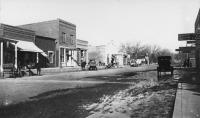
Farmington is approaching a milestone that invites a long and affectionate look backward. The town officially incorporated on July 15, 1901, and its upcoming 125th anniversary offers an opportunity to appreciate the people, landscapes, and historical moments that shaped it. With insights and resources provided by the Farmington Museum, these historical stories and fun facts explore how the town grew from a collection of farmsteads into a vibrant regional hub. Farmington’s early story is filled with ingenuity and resilience, and its present-day energy reflects just how far that story has come. We hope you enjoy learning about the history of Farmington and the spaces and people that shaped the thriving community it is today.
Downtown Streets
Visitors to town often notice something unusual about the first three blocks of East Main Street: the cross streets don't quite line up. Unlike the predictable grid found elsewhere, the roads here seem to jog awkwardly, almost intentionally. Local tradition offers a compelling—and rather personal—explanation for this architectural oddity.
According to longtime residents, the unusual layout stems from a bitter divorce between A.F. and Julia Miller, one of the town’s early power couples. Julia retained the lots on the north side of East Main Street, while A.F. took the south. But Julia reportedly made one final vow: her land would never touch his. True to her word, the street grid on the north was shifted just enough so that cross streets would never align directly with those on the south. The result is a permanent misalignment in the heart of town—an architectural reminder of a personal feud.
Whether every detail of the tale is historically verified or not, the story has become part of local lore, passed down through generations. And today, the jog in East Main remains a subtle, enduring monument to the Millers’ divided legacy.
A Look Back at the Origin of Orchard Park
Nestled in the heart of Farmington, Orchard Park holds a rich history that dates back to the early 20th century. Originally known as Hunter Plaza Park, the land was generously donated to the town in 1902 by William and Clara Hunter, with the condition that it always serve as a public park.
William Hunter, a prominent local businessman, also owned Hunter Mercantile on Main Street. The park quickly became a central gathering spot for the community. A large gazebo, once located toward the back of the park, served as the stage for Saturday evening concerts during the summer months and was a focal point for parades and special events.
Hunter Mercantile Building: A Historic Cornerstone
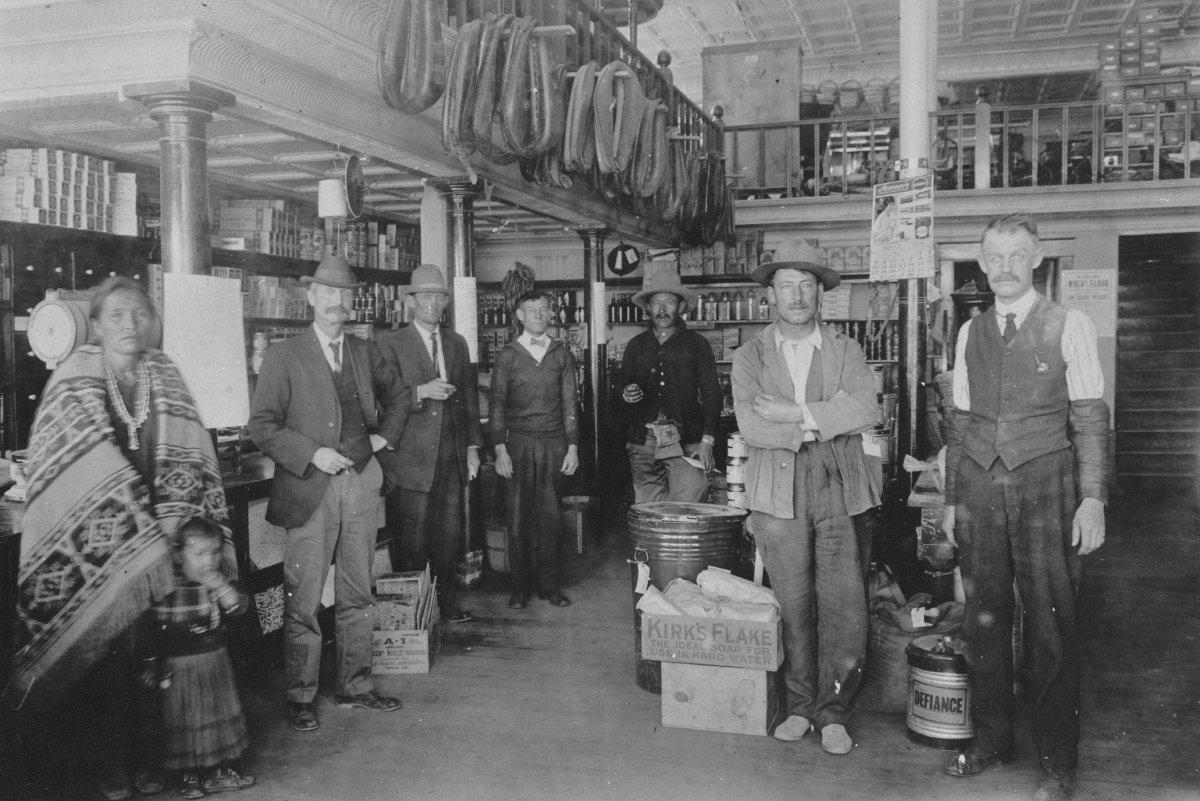
Built in 1911 by early settler William Hunter, the Hunter Mercantile Building stands as a unique piece of local history. Now home to the Dusty Attic, this distinctive L-shaped structure was designed to wrap around the First National Bank, maximizing its presence at the corner of Main Street and Orchard Avenue.
In its early days, the mercantile housed a clothing store along Main Street and a grocery store—with a full-service meat market—in the Orchard Avenue wing. It was a bustling hub for the community’s everyday needs. One of the building’s most striking features, the original tin ceiling, remains intact and can still be admired today inside the Dusty Attic, offering visitors a glimpse into the craftsmanship of the early 20th century. This historic site continues to serve the community, preserving both its architecture and its legacy.
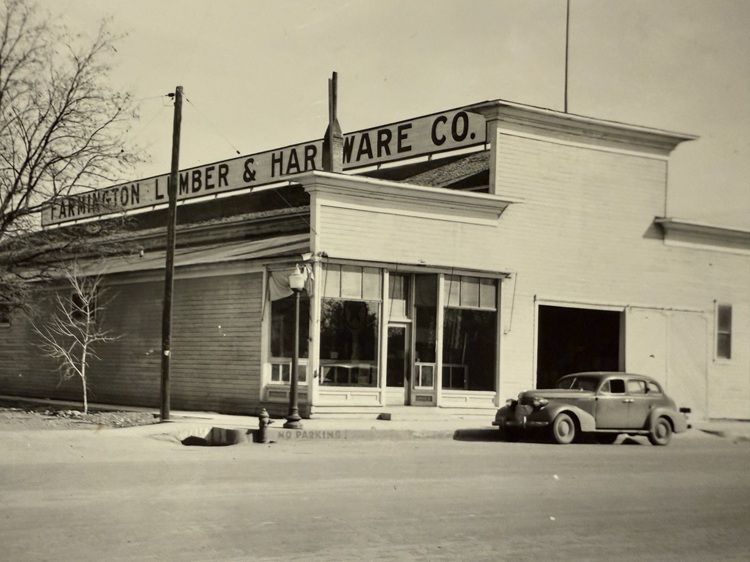
A Legacy of Craft: The Historic Gibson Lumber Company Building
Farmington Lumber and Hardware Company was one of the early businesses that built Farmington, NM. In 1908, Charles C. Mumma came from Ohio to Durango, CO to work for his uncle, Charles Herr, in his lumber business. Upon the completion of the narrow-gauge railroad from Durango to Farmington, Mumma moved to Farmington to start his own lumber business.
After a fire in 1916 (rumored to have been started following a bar room dare) destroyed the original building, Mumma bought the Gibson Lumber Company building, located two blocks north on Main Street, and moved his business to the present location.
The Gibson building was built in 1908, and has been in the family ever since. H. Merrill Taylor, Mumma’s son-in-law, bought into the business in 1944. Later, Merrill’s son, Tom Taylor (former Mayor and State Representative), did the same in 1972. After 79 years in the same location, the lumber business closed in 1995 and immediately reopened to an exciting future in the world of art, with private studio spaces available to local artists.
After the success of The Studios, Artifacts Gallery opened to the public in 1999. The Gallery is operated by Tom’s wife, Bev, and daughter, Tara Taylor. Fast-forward another 16 years, and the dream expanded with yet another remodel and the inclusion of the warehouse portion of the old building as part of the gallery.
The most recent expansion included an event exhibit space available for after-hour rentals, as well as the Studio Bake Shoppe with an Espresso bar. The old building has now come full circle with remnants of its lumber yard history integrated into a new comfortable space that is quickly becoming a lively gathering place in Historic Downtown Farmington. (Details provided by the Taylor family)
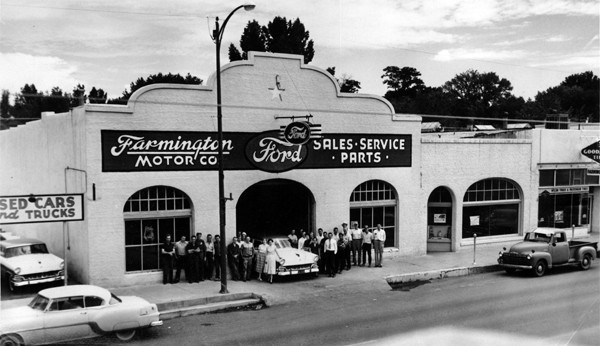
The Alamo Building
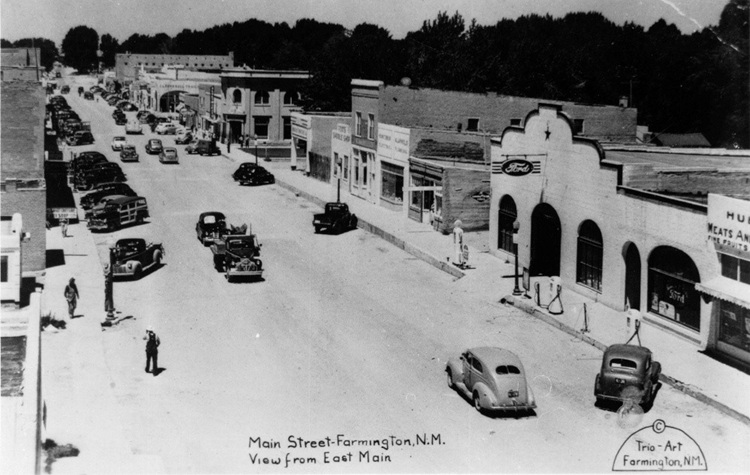
The building at 122 East Main Street is a distinctive example of early-20th-century commercial architecture that employed a false front, a façade designed to give the structure a more imposing or stylistic appearance than its simple form would otherwise allow. Constructed in 1915, the building originally housed Alamo Motors and the Star Garage, later becoming home to a branch of the Ford Motor Company. Period photographs indicate that gas pumps once stood along the curb in front of the building during the 1940s, reinforcing its role as a service and automotive hub for the community.
The façade itself was likely intended to evoke the iconic profile of the Alamo Mission in San Antonio, Texas, a popular stylistic reference in the early 1900s. Today, despite changes in use and the evolution of Main Street, the building remains a recognizable landmark and currently houses Lloyd’s Carpets & Draperies. Its unusual front continues to draw attention, offering a visual reminder of the town’s early automotive era and the architectural creativity of the period.
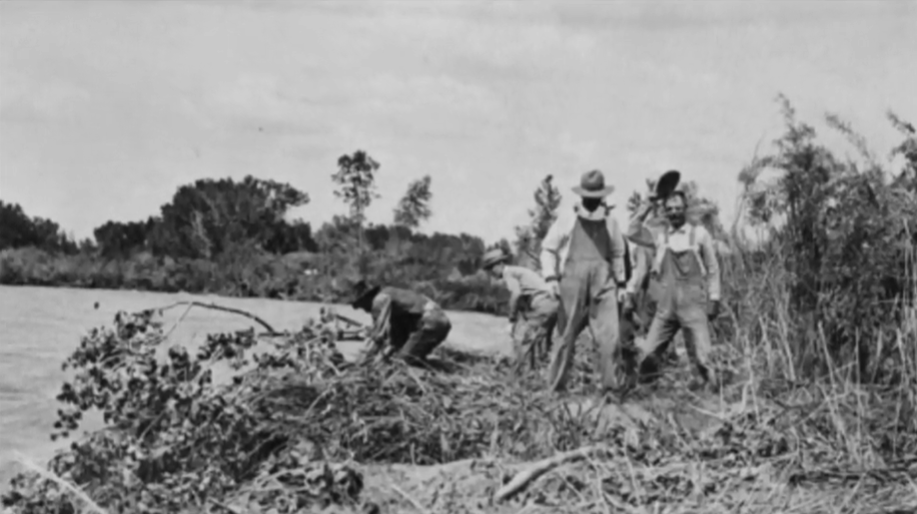
The Flood of October 5, 1911
Many of the region’s most damaging floods have occurred in the fall, and none was more devastating—or more widely reported—than the flood of October 5, 1911. After an unusually rainy summer, the ground was already saturated when a new round of storms swept in from the Durango area. The volume of rainfall was so great that the Animas River and all of its tributaries surged out of their banks, sending a destructive wall of water downstream toward the confluence with the San Juan River and beyond.
Residents living upriver sent urgent warnings by horseback and telegraph to communities in Farmington and Shiprock, giving people as much time as possible to prepare. At the power plant on East Main Street, crews worked around the clock to keep driftwood and debris from clogging the ditch that fed the water wheel. Their efforts paid off—by keeping the channel clear day and night, they were able to preserve the wheel as the floodwaters raged past.
The Farmington Times-Hustler reported the aftermath in its October 12, 1911 edition, summarizing the disaster in stark, simple terms: “Twenty-five miles of railroad washed away, 150 miles of river bottoms devastated with the San Juan and Animas Rivers higher than ever in the memory of the oldest residents. About 50 families in the county lost their homes.”
Across the region, bridges were swept away. Every San Juan River crossing at Blanco, Bloomfield, Farmington, Fruitland, and Shiprock was destroyed. On the Animas River, two bridges at Twin Crossings were heavily damaged, leaving a train stranded between them; the crew and passengers bound for Durango were forced to abandon it. Bridges at Cedar Hill and Flora Vista were also lost.
Mail service immediately shifted to stage lines, and despite the scale of the destruction, railroad crews managed to restore service by November 23—just forty-eight days after the flood. Recovery for local families, farms, and businesses took far longer. Some rebuilt on their original sites, while others relocated to higher ground. For many, the 1911 flood marked the beginning of an entirely new start.
Historic Fun Facts from the Farmington Times Hustler
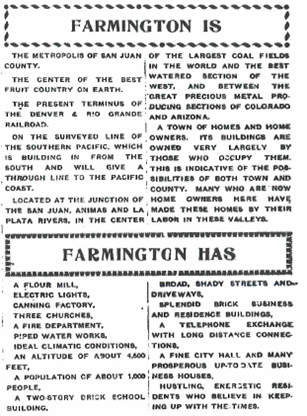
On August 17, 1911, the local newspaper, Farmington Times Hustler, published natural advantages and fun facts about Farmington. Here is a partial listing of that information and an image of a similar excerpt from a November 2, 1906, issue of the Farmington Enterprise.
- Number of miles of irrigating ditches in the county: 280
- Acres of hay land: 10,000
- Acres of orchard and fruit lands: 5,000
- Acres of grain lands: 5,000
- Acres of other crops: 15,000
- Estimated hay production: 1910, 50,000 tons
- Estimated fruit production: 1910, 10,000,000 pounds
- Estimated grain production: 1910, 8,000,000 pounds
- Natural resources awaiting development: coal, oil, lime and natural gas
- Farmington has no saloons
- Farmington is incorporated
- Farmington has a city park
- Farmington has a brass band
- Farmington has five churches
- Farmington has two good hotels
- Farmington has 2 National banks
- Farmington has a Board of Trade
- Farmington has a $4,000 town hall
- Farmington’s population is 1,200
- Farmington is lighted by electricity
- Farmington has a piped water system
- Farmington is the commercial center of the county
- Farmington is the center of the county telephone exchange
- Farmington pays one-third of all the taxes paid in San Juan County
- Farmington is in the center of the greatest fruit belt in the southwest
- Farmington has the best schools of any town in northern New Mexico, including a complete High School course
Farmington Today: A Story Still Unfolding
Visitors to Farmington can feel its history throughout the town. The streets, neighborhoods, and surrounding landscapes reflect decades of resilience, creativity, and community spirit. As Farmington celebrates its 125th anniversary, our rich heritage becomes even more remarkable. Exploring downtown or visiting local museums offers a glimpse into the people and events that shaped the valley, giving travelers a sense of how far Farmington has come and inviting them to celebrate the history that continues to define the city today.