
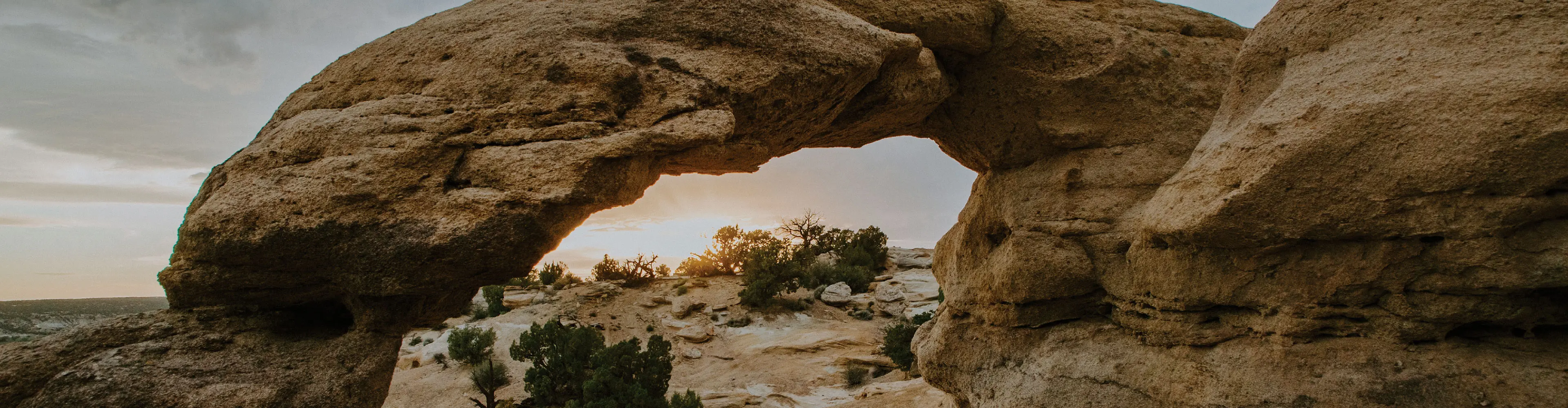
The area around Farmington in northwestern New Mexico is well-known for its unique landscape. Not only do people come from around the world for the recreational activities that accompany it, but we also see visitors who come to this region just to experience the natural beauty itself.
Among the draws are the Bisti/De-Na-Zin Wilderness and Ah-Shi-Sle-Pah, where Kialo Winters and Navajo Tours USA lead year-round tours.
We recently caught up with Kialo for a two-part series to learn more about De-Na-Zin and Ah-Shi-Sle-Pah, their relationship with our historical and modern-day Indigenous cultures, and what visitors should know about how to have the most fulfilling experience.
In his own words:
“My name is Kialo Winters of Diné and Zia descent, and I'm the owner of Navajo Tours USA. We're a Diné-owned company offering guided day tours into Bisti/De-Na-Zin Wilderness, Ah-Shi-Sle-Pah, Chaco Canyon, and Shiprock. Our business mission is simple: to give travelers safe, respectful access to these landscapes, and to share our stories guided by Indigenous people. Everything we do sits on that foundation.”
Here’s part one on the uniqueness of these areas, what to expect on a visit, and why guided tours are so crucial to enhancing the experience and understanding of these spaces. Don't miss part two!
What makes Bisti and Ah-Shi-Sle-Pah unique?
VF (VISIT FARMINGTON): For people who have never heard of the Bisti/De-Na-Zin, how do you describe it in a way that captures what makes it special?
KIALO: Bisti is what happens when you take an ancient inland seabed, lift it up, and let 70 million years of wind and water carve it down.
It's the final retreat of the Western Interior Seaway from the San Juan Basin. The Fruitland Formation is Late Cretaceous sediment and records coastal-plain swamps, river channels, and peat mires, which is why it's the basin's main coal-bearing unit and why Bisti's hoodoos weather out of interbedded sandstone, shale, and coal. It also produced the area's hadrosaur and early tyrannosaur fossils like the Bistahieversor.
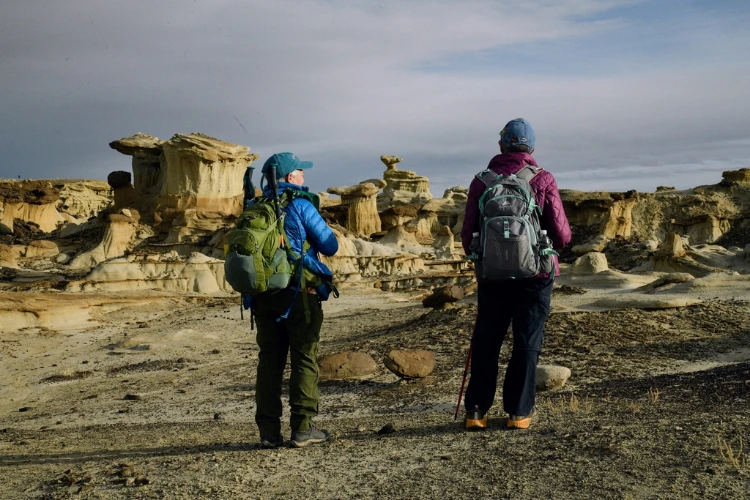
You're walking through hoodoos, petrified wood, and stone "eggs". All of it sculpted into shapes you wouldn't believe unless you saw them with your own eyes.
But more than the geology, what makes Bisti special is the silence. There's no signage, no marked trail, no cell signal; just you, the land, and the wind. It's one of the few places left where you can still feel rugged backcountry exploring.
VF: What would you tell first-time visitors?
KIALO: Slow down. Most people show up expecting a hike — Bisti is not really a hike; it's a wander. There are no marked trails, the formations all look similar at a distance, and what's worth seeing isn't always what's loudest. Bring more water than you think you need, wear sturdy shoes, and give yourself permission to get quiet. The land has a way of meeting you halfway when you do.
VF: What makes the Bisti/De-Na-Zin different from other hiking or high-desert destinations in New Mexico?
KIALO: Most desert destinations in New Mexico are built around a single iconic view; a vista point, a marked trail, an overlook. Bisti is the opposite.
It's 45,000 acres of badlands with no developed trails, no facilities, and very little signage. You're navigating by landmarks, not signs. It's also one of the few places in the Southwest where you can still find 75-million-year-old fossils sitting where they eroded out of the rock.
That combination of geological scale, paleontological richness, and pure remoteness is hard to find anywhere else.
VF: What makes Ah-Shi-Sle-Pah Wilderness different from other hiking or high-desert destinations in New Mexico?
KIALO: The Ah-Shi-Sle-Pah valley is Bisti's quieter, more remote cousin. It's smaller — about seven thousand acres — but more pristine, with far fewer visitors.
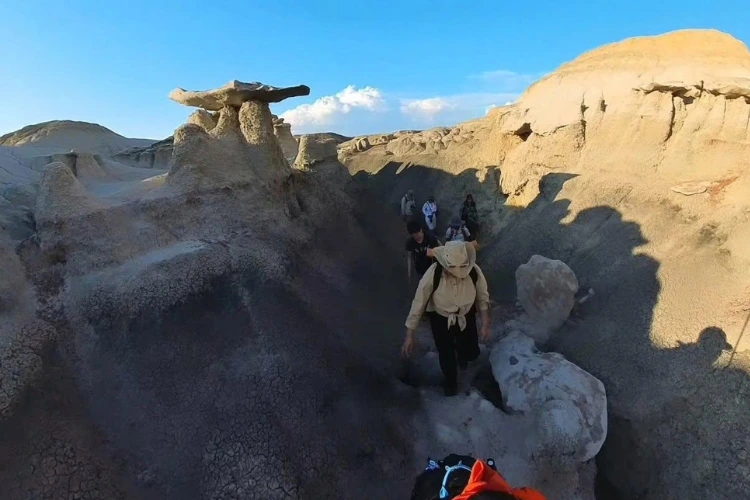
The name itself, Ah-Shi-Sle-Pah, comes from our Diné language and refers to the amber and milky white crystals that paint the land. The hoodoos there are some of the most dramatic in the Southwest, like the Alien Throne, Giant Mushroom, and Sentinel. And because so few people go there, you often have a formation that took millions of years to form entirely to yourself. The trade-off is that it's harder to reach, easier to get lost in, and unforgiving if you're unprepared.
VF: Are there certain areas, rock formations, features, or viewpoints that tend to leave the biggest impression on guests?
KIALO: In Bisti, the Egg Hatchery — also known as the cracked eggs — are usually the first thing that stops people in their tracks; they're these strange, polished stone spheres scattered across a plain, and nobody is ever fully prepared for them.
The Stone Wings always pull strong reactions too. In Ah-Shi-Sle-Pah, it's almost always Alien Throne and Giant Mushroom. But honestly, the moment guests talk about the most isn't usually a single formation; it's the first time we stop walking, sit down, and they realize how silent it is. That silence stays with them longer than any photograph.
VF: How do you balance helping guests see iconic formations while also encouraging them to appreciate the landscape as a whole?
KIALO: We tell travel guests up front that we'll get to the formations they came to see, but on the way, I'm going to ask them to slow down for the things they didn't. The micro-fossils underfoot, the layering in the cliffs that tells you what the climate was doing 80 million years ago, the way the light shifts the color palette around every corner.
Why guided tours matter so much
VF: Since the wilderness is remote and routes are largely unmarked, what are the biggest advantages of visiting with a guide?
KIALO: Safety is the first one, plainly. Both Bisti and Ah-Shi-Sle-Pah have no trails, no cell service, and very few landmarks that look different from a distance and people get turned around there every season, sometimes seriously so.
Beyond that, a guide saves you hours. We know where the formations are, where the light is best at what time of year, and how to read the washes after a rain.
And then there's the layer you really can't get from a map: the cultural, geological, and ecological context that turns "weird rocks" into a story you'll carry with you for the rest of your life.
VF: What local knowledge or context can a guide provide that visitors would likely miss on their own?
KIALO: A few things visitors almost always miss without a guide: the meaning of the place names themselves — De-Na-Zin, "standing rock formations," is named for the verbiage of standing hoodoos, and Ah-Shi-Sle-Pah comes from the Diné language for the crystals painting the land.
The geological story of how an inland sea became badlands. The fact that the fossil record here documents the last few million years of the dinosaurs on this continent. And the cultural weight of the land; these are ancestral Indigenous lands, and there are pieces of oral tradition tied to features in the landscape that don't appear in any guidebook. We share what's appropriate to share.
What to expect as a visitor in De-Na-Zin and Ah-Shi-Sle-Pah
VF: What does a typical guided tour look like from start to finish?
KIALO: We meet guests at a pre-arranged trailhead, brief them on what to expect, and then we caravan or drive together out to the wilderness trailhead. From there we walk in, pace set by the group, not by the clock.
A typical day in Bisti is four to six hours on the land, with regular stops to talk through what we're seeing, take photos, eat snacks, and listen. We circle through the formations that fit the group's energy and interests.
VF: How much hiking should visitors expect, and what is the terrain like?
KIALO: Plan on four to six miles of walking across the day, though it doesn't feel like that — we move slowly and stop often.
The terrain is dry, uneven, and exposed. You're walking on clay, sandstone, packed sand, and the occasional wash. There's almost no shade, very little elevation gain, but the footing is what catches people; clay turns slick after rain, and the small ridges and washes add up.
Most guests in reasonable health do it comfortably. We pace for the group, not the strongest hiker in it.
VF: What should guests bring with them for the best experience?
KIALO: One liter of water per person minimum; more in summer.
Sturdy shoes — not sneakers, not sandals. A wide-brim hat, sunscreen, sunglasses. Layered clothing, because mornings and evenings can be cold even when the day is hot. Snacks and a light meal. A camera if you're inclined.
And honestly, an open mind.
VF: Do visitors tend to come for photography, hiking, geology, cultural insights, solitude, stargazing, or a mix of everything?
KIALO: Most come for one of those reasons and leave caring about all of them. Photographers come for the formations and end up asking about the Diné names. Geologists come for the Cretaceous record and end up sitting in silence at sunset. Stargazers come for the Bortle 2.3 skies and end up wanting to know who walked these lands before.
VF: Why is Bisti such a memorable place for visitors and photographers?
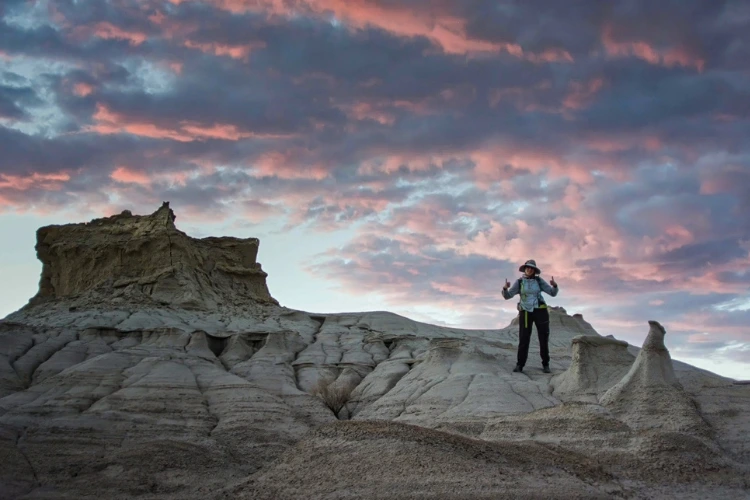
KIALO: Because nothing else looks like it. The hoodoos, the eggs, the petrified wood, the cracked formations — they don't read as landscape so much as sculpture. For photographers, the low sun in the early morning and late afternoon turns the clay every shade between cream and bronze, and the shadows work for you.
But the deeper reason it's memorable is what I keep coming back to: the silence, the scale, and the sense that you're walking through something much older than you. Some places are meant to be felt, not photographed. Our landscapes are both.
VF: Why is Ah-Shi-Sle-Pah such a memorable place for visitors and photographers?
KIALO: Because of how few people are ever there. The hoodoos at Alien Throne and Giant Mushroom are some of the most dramatic in the country, and most visitors will have them entirely to themselves. For photographers, that solitude is part of the shot, you don't have to wait for anyone to leave the frame because there's no one there.
And for everyone else, Ah-Shi-Sle-Pah and De-Na-Zin are both geological wonders and grounding spots for thousands of years of ongoing history and culture. When you experience this environment through the knowledge of that culture, you come away with greater appreciation for not just what your senses picked up on the way, but the context for what that means and why it matters.
To keep reading about the Bisti, Ah-Shi-Sle-Pah, and Navajo Tours, we have a second part to this interview with Kialo on planning your visit, seasonal concerns, education and culture, and being a responsible visitor and steward.