
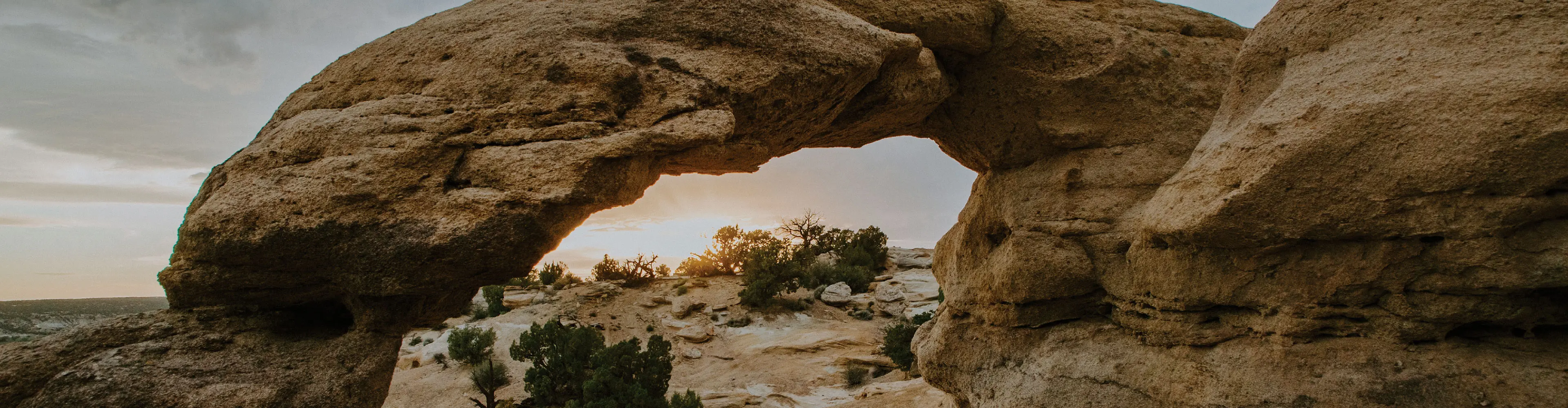
Welcome to part two of our interview with Kialo Winters, the owner of Navajo Tours USA, who takes visitors on guided tours through the ancient Bisti/De-Na-Zin Wilderness and Ah-Shi-Sle-Pah.
In the first part, we spoke to Kialo about the confluence of this area’s geology and history plus how visitors can be sure they’re prepared. Today, we’re continuing that discussion with a focus on this area’s cultural significance, the stewardship of knowledge, and visitors’ own responsibilities — plus his own favorite experiences as a guide and the recurring themes he appreciates the most.
Let’s dive in:
Understanding the seasons and planning appropriately
VISIT FARMINGTON: What time of year do you think is best to visit the Bisti/De-Na-Zin and Ah-Shi-Sle-Pah, and why?
KIALO: My favorite windows are mid-September through early December, and mid-March through mid-May.
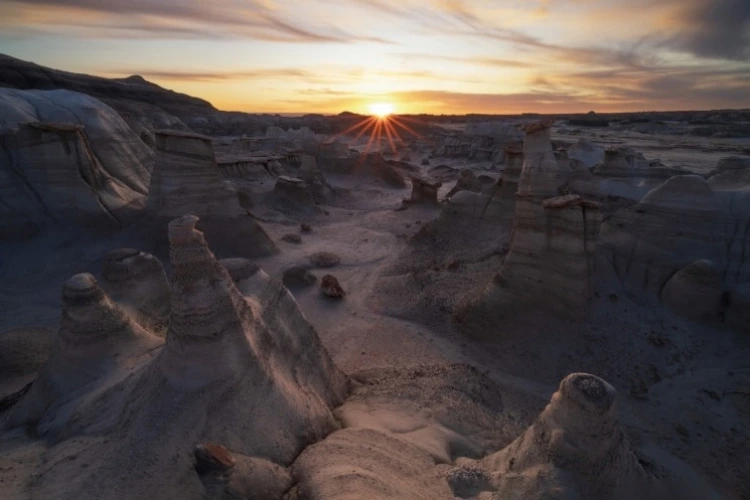
Fall gives you cooler temperatures, low sun for great light, and stable weather. Spring gives you green washes after the snowmelt and dramatic skies. Summer is doable but hot — we're starting early and finishing by midday, or starting late afternoon and finishing at dusk. Winter is beautiful, but cold mornings and the occasional muddy clay can change a plan fast.
Whatever season you pick, we work around the weather, not against it.
VF: How far in advance should a visitor book a guided tour?
KIALO: Two to four weeks is comfortable for most of the year. For peak windows, fall foliage, spring break, and the lead-up to our November tours, I'd say four to six weeks out. If you're coming from outside the region and building flights and lodging around the tour, the earlier the better. We keep group sizes small on purpose, and dates fill faster than people expect.
Cultural significance and educational insights
VF: What aspects of the area's geology, fossils, and natural history do you most enjoy sharing with guests?
KIALO: I love telling guests that they are walking on the bottom of an ancient inland sea, that the cliffs above them were once river deltas and swamps where late-Cretaceous dinosaurs lived, and that the badlands they're looking at are the long work of 70 million years of erosion.
The Fruitland and Kirtland Formations hold the most important late-dinosaur fossils on the continent, like the Pentaceratops, Bistahieversor, and Parasaurolophus. Standing in a place where the geology tells you what the last few million years of the dinosaur age looked like, in real time, is a kind of perspective that's hard to come by anywhere else.
VF: Are there cultural or regional stories that help visitors better understand the landscape? Is there anything that you would like to share about this in the blog?
KIALO: Yes, and I'll share what is appropriate to share publicly.
These lands are part of ancestral Indigenous lands. The names themselves carry meaning: Bistahí, the place among the shale formations; De-Na-Zin, the place of standing hoodoos; Ah-Shi-Sle-Pah, the amber and milky white crystals.
There are oral traditions tied to specific features here, and the land features in our cosmology, but some of that knowledge is not for publication. As Diné guides, our responsibility is to share the cultural context that opens a guest's eyes without crossing into knowledge that belongs to the community alone. There's a fine line between educating and over-explaining, and we’re careful with where we walk it.
VF: How do you approach sharing the significance of the area in a meaningful way?
KIALO: By layering it. We start with what people can see, the formations, the colors, the fossils, and once they're paying attention, we add the culture and the cosmology. We don't lecture; we tell stories, and we let the land do the rest.
We also tell guests honestly when something is sacred or restricted, and we name why we’re not going further. People respect that more than a forced answer.
VF: What do you hope visitors leave understanding about this landscape that they did not know before?
KIALO: Three things: One, that the land is alive; geologically, ecologically, and culturally, and not a museum exhibit. Two, that Indigenous people are still here, still telling these stories, and still stewarding these places. And three, that the privilege of standing in a place like this comes with a responsibility to protect it, to talk about it carefully, and to advocate for the communities that have always been its caretakers. If a guest walks out with those three things, the tour did its job.
How to be a responsible visitor to De-Na-Zin and Ah-Shi-Sle-Pah
VF: Because these are protected wilderness areas, what are the most important leave-no-trace practices visitors should follow?
KIALO: Pack out everything you pack in, including food scraps and anything biodegradable. Stay off fragile clay and cryptobiotic soils whenever you can; one footprint can take years to recover. Do not collect rocks, fossils, petrified wood, or "souvenirs". What looks like a small piece to you is part of a record that took millions of years to lay down, and it's federally protected. Don't climb on fragile formations. Don't carve anything, don't paint anything, and don't stack stones. Leave no trace.
VF: What common mistakes do visitors make that can harm the landscape or lessen the experience?
KIALO: The most common physical mistakes are disturbing fragile clay at the base of formations for a photo, and pocketing petrified wood or a mineral fragment.
The most common experiential mistake is moving too fast, racing to check formations off a list and missing the landscape they're walking through. The third mistake is showing up underprepared: not enough water, the wrong shoes, and no plan for the weather. Any one of those can turn a great day into a bad one fast.
VF: Are there any special seasonal considerations visitors should know, such as wildlife sensitivity or access concerns? We understand that raptors are especially sensitive to disturbance from February 1st to July 1st.
KIALO: Yes, you're right about the raptors. From February 1st through July 1st, golden eagles, peregrine falcons, and other cliff-nesting raptors are nesting in the area, and even brief disturbance can cause nest failure. During that window, we adjust routes to keep distance from known nesting cliffs.
Beyond raptors, monsoon season, roughly July through early September, can wash out the unpaved roads in and out within an hour, so we watch forecasts closely. And in winter, the same clay that gives the Wilderness its beauty turns into something you cannot walk or drive on after a heavy snow or rain. We plan around all of it.
VF: How can travelers help protect these areas for future visitors?
KIALO: Book with Indigenous-owned guides or local businesses whenever you can; your dollars go back into the communities that have always cared for this land. Don't geotag the most fragile or lesser-known formations on social media. The surge of visitors that follow after a viral post can do real damage in a single season. Follow leave-no-trace religiously.
Speak up when you see other visitors collecting or climbing where they shouldn't. And support the policy work of public-lands protections, BLM funding, and tribal consultation requirements.
Kialo’s favorite parts of guiding, memorable moments, and last takeaways
VF: Do you have a favorite memory from guiding?
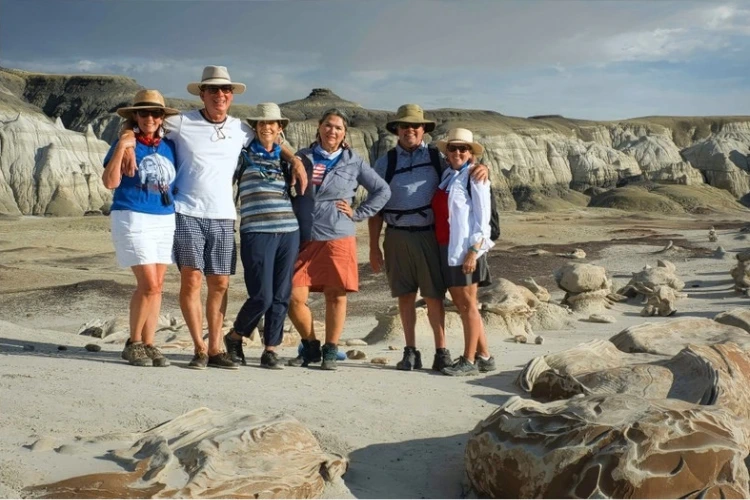
KIALO: I remember a married couple who had spent their entire careers as geologists in the eastern United States. During one tour, they became fascinated by a mineral fracture exposed on a rocky tabletop formation. They traced the line with their hands, studying the contrasting layers on either side, and their excitement was contagious.
At one point, they both started laughing, and the wife turned to me and said, “This is incredible. You work among such geological anomalies and phenomenal examples of sediment movement frozen in time.”
That moment stayed with me. As guides, it's easy to think our role is to share knowledge and interpretation. But experiences like that remind me that sometimes I'm not the expert in the conversation. Sometimes my role is simply to help people arrive at the right place, at the right time, where their own curiosity, expertise, and sense of wonder can come alive.
VF: Has there been a guest reaction or moment that really stayed with you?
KIALO: A few years ago, a small family joined me for a Bisti Wilderness tour in October. As we arrived at the Stone Wings during golden hour, dark rain clouds moved on the eastern horizon and began to glow with shades of pink and orange, like cotton candy stretched across the sky.
We continued to the next overlook, and something even more remarkable happened. A rainbow emerged, arching across the landscape in a perfect full arc. The family stood quiet for a moment before one of them said they never imagined they would see something so surreal.
Moments like this remind me why I do this work. It isn't about the photographs. It's about helping people connect with a place in a way they never expected.
VF: What keeps you passionate about introducing people to this place?
KIALO: The land is older than any of us, and it doesn't need us. But the bridge between people who want to understand it and the community that has always cared for it needs someone to walk it, and walk it carefully. Every group we take out is one more set of people who go home with a real story about Indigenous lands, told in a Diné voice. That work doesn't get old. And every once in a while, somebody steps out into the silence and is changed by it. That's enough to keep me going every year.
VF: If you could give one piece of advice to someone considering their first visit, what would it be?
KIALO: Come with humility and curiosity. Listen more than you speak. Don't try to see everything; try to see one thing well. And remember that some places are meant to be felt, not photographed.
If you bring that idea with you, the land will give more than you came for.